
Galactic Endurance Championship
Racing sublight spaceships is not a new concept; it dates back to the early years of the Late Low Age, or Kinetic Age, when the first improvised low Earth orbit races emerged between Lagrange stations. Though many space racing competitions exist across human space, from tiny events around moons or asteroids to gigantic interstellar cups, none are more prestigious and popular than the Galactic Endurance Championship and its three annual races.
Endurance space racing it, at first glance, an odd concept: indeed, if the goal is to merely careen across space for as long as possible, any spaceship may suffice, and the race will not be very interesting to watch. As with industrial-era motorsport (a fantasy of the past for most people), endurance space racing needs rules and a track. In endurance races, the track is discrete: it is made of a multitude of relays, signalled by ring-shaped beacons, that spaceships must pass through in a defined order as to complete a lap. Whoever completes the most laps in a set amount of time (usually 25 or 16 days) wins. The powered or unpowered trajectory between each relay is left to the discretion of the pilots, though the tracks are configured in such a way that there may often be two or more optimal paths. The rules ensure that everyone races within the same broad performance envelope, guaranteeing spectacle – even if, by the very nature of space, endurance racing is much more or a navigator’s game than a pilot’s game.
Endurance ships are, by definition, fast. If “slow races” involving ships with low delta-v have a dedicated following, they remain niche, for they require as much, if not more, endurance on the part of the audience than the crews; it does take patience to follow a single race for months on end, as ultralight spaceships perform Oberth manoeuvres and Hohman transfers across the moon system of a gas giant. In order to stress both crews and engines to their limit, mainstream endurance races allow vessels to mount seriously powerful engines: fusion candles or gas-core nuclear rockets are not a rare sight in endurance racing, and the delta-v limits are generous enough to make room for “flip and burn” brachichrostone trajectories and very aggressive manoeuvring around moons, including daring aerobraking to shave off a few precious kilometres per second. Endurance ships are not constantly burning, but they use their engines much more aggressively than even cutting-edge interceptors, making mechanical excellence as important as tight navigation and daring piloting.
The rulebooks are very long, contain multiple caveats and exceptions (most of them written after blatant examples of unprovable cheating), and try to maintain fairness beyond ship design: for instance, there is a hard limit on the budget of a racing team, and non-biological crews are acceleration-limited, in order to avoid giving artificial intelligences too much of an edge. Remote-controlled ships are only allowed if *every* participant agrees to leave their cockpit empty – and indeed, most races ban them. A fair amount of rules-lawyering is accepted, and even expected; endurance races are also won and lost on minute technical details, and the staunch “engineer culture” in endurance racing means that victories based on such technicalities are not considered more or less “fair” than victories acquired at the finish line. Clever is fast, fast is clever. And the teams – most of them representing prestigious coop-coms, such as the Moon Communes – are very clever.
The quirks of space endurance racing are too long to list in full, and the sport already has quite the storied existence. Many anti-g techniques like liquid breathing and dedicated monad drugs were pioneered in endurance racing, and not in the military, where sustained acceleration is a marginal part of an interceptor’s performance. Ever since fusion drives were introduced in endurance racing, artificial aurorae born out of fusion plume byproducts have begun appearing on the gas giant near the tracks, gleaming for days after the races. “Safety ships” need the capability to quickly intercept disabled or otherwise unresponsive spacecraft; as such, they have some of the highest available delta-v in human space. Surprisingly enough, no one ever died. Experimental Orion drives were banned after the “Tiangong Incident”. Podiums have up to ten seats, instead of three: it is not rare for most of the participants to reach it in a given category.
The Galactic Endurance Federation defines three official ship classes in endurance races. Though they all compete against each other, they are also ranked within the same class.
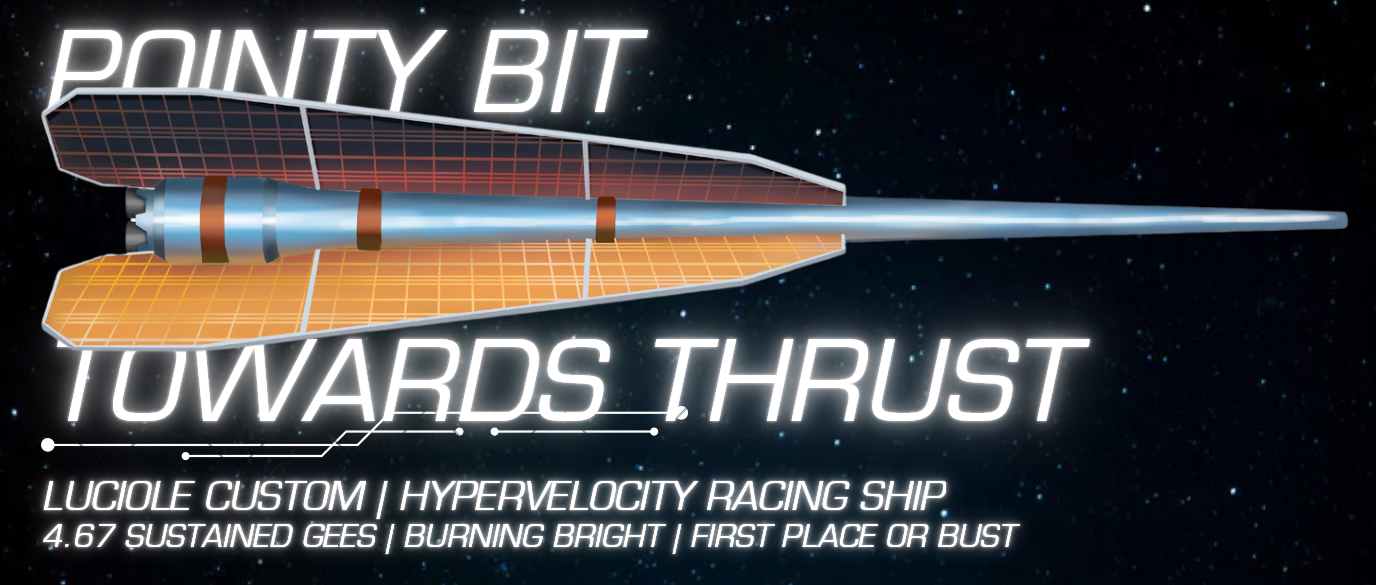
Galactic Performance (GP) is the most sought-after and exclusive class, made of dedicated, high-performance ships with very high delta-v and either fusion candles, gas-core nuclear rockets or high-performance liquid-core rockets. Fusion drives tend to be dominant. The very generous performance envelope of this class makes for a riveting race, giving equal attention to engineers and pilots alike, with multiple-hour high-g burns and brachichrostone trajectories galore. It is dominated by ad hoc prototypes, albeit a few re-engineered Lucioles make the qualifications each year. Most championship winners hail from this class.
Near-Stock Ship (NSS) is a middle-of-the-road class that exclusively integrates “stock ships”, with racing modifications. Lucioles and Almaz Couriers make for the bulk of the class, but heavily redesigned Mansa Musa cargo ships or even Inyanga explorers can be competitive. Delta-v envelopes are much stricter than in the GP class to account for the diversity of ship profiles: high-performing Lucioles may be forced to carry less reaction mass than a Mansa Musa for instance, in order to even the playing field. As such, the NSS class is considered more of a “pilot and navigator’s game”, and allows smaller teams a chance to see the podium.
Race Democracy (RD) is a class that aims at providing the opposite experience of the GP class. A very staunch spending ceiling encourages teams to use second-hand vessels, or even repurposed derelicts, trying to squeeze as much performance as they can out of the cheapest possible hulls (safety expenses do not count towards the ceiling). The result is a very colourful class, full of unique machines and oddities that would otherwise never take part in an official race, like chemically powered Lucioles or spacecoaches. The RD class is known for its spectacle and camaraderie: merely *finishing* the race is already an exploit, and coupling with a disabled vessel to help it finish its laps awards special points.
In the Galactic Endurance Championship (GEC), crews compete over three races, earning points depending on their final ranking, and crowning a champion at the end of every biennal edition. There are only three races in the GEC, as interstellar travel times, concurrent competitions and the duration of the races themselves limit the available spots. Teams keep the same spaceship type for the entire championship, and are only allowed a single full hull replacement (engine parts can be swapped, albeit not the engines themselves).
The three GEC races are as follows:
The 25 days of Jupiter: the original endurance circuit, a simple, straightforward race around the airless moons of a mostly empty gas giant system, with aerobraking sequences near the atmosphere. High levels of radiation force ships to carry a lot of shielding mass, making it the slowest GEC race.
The 16 days of Kailash: a complex race around the third gas giant of the Elora system and its sprawling envelope of moons and rings. This very technical circuit offers ample opportunities for aerobraking, ring traversal and last-minute course corrections. Its beacons are traditionally placed very close to moon surfaces, requiring tight approaches, while a clement radiation environment allows vessels to go light and fast.
The 20 days of Eleutheria: a deep space race set in a “pocket star system” made of a handful of icy worlds and a brown dwarf orbiting an M-class red dwarf within a very small radius. Low radiation levels and large distances between the beacons make this circuit a true velocity race: vessels are almost always burning at full power for 20 days straight, stressing engines and crews to their limit. The least navigationally complex but most stressing race, it is also set in the middle of the racing season, forcing crews to strategise, as not to enter the 16 days of Kailash with an ailing vessel or an exhausted crew.
As of today, no team has ever won the three races consecutively, though the Moon Communes regularly make it to second or third place in all installments.
Illustration by Valahor for Starmoth.
All content in the Starmoth Blog is © Isilanka
Written content on Starmoth is distributed under a Creative Commons Attribution Non-Commercial Share-Alike 4.0 license