
Twilight's Gate
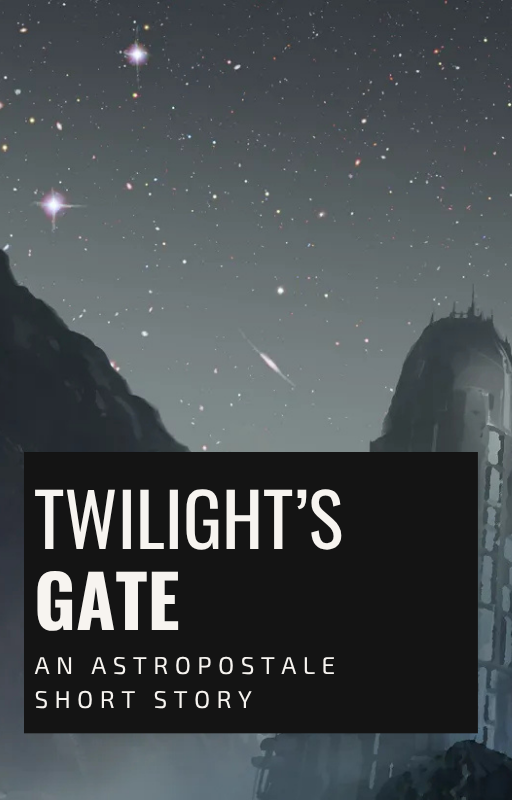
When Courier Seven reintegrated realspace, a flash of blue light shimmered through the augmented reality windows, then dissipated into the sheer blackness of space. Isaac-Isabeau held their breath. The cameras only caught a handful of celestial bodies; the Milky Way strolled lazily through a corner of the image.
“Recalculating our current location from nearby pulsars,” said Talasea. “Our margin of error on this translation is firmly under two hundred kilometres. Do you have anything on infrared?”
Isaac-Isabeau flicked a switch. The stars became grey, and Twilight’s Gate suddenly appeared. The ring was twenty-two thousand kilometres across, and filled half the visible sky; it was off by a few degrees, relative to Courier Seven, and Talasea managed to get a glimpse of the inner edge. Though not as featureless as the outer side, it remained devoid of seas or continents; for Twilight’s Gate, a great work of the Sequence, had been drifting in the void for tens of thousands of years. Thermal infrared showed a surface temperature close to the cosmic background. It was a citadel of ice – water, oxygen, carbon, hydrogen ice, perhaps, even.
“Not a fan,” sighed Bubbles. Her avatar donned a little knit cap.
Talasea’s nav screen displayed a green icon.
“Incoming translation,” she said. “It’s the Malatesta.”
Isaac-Isabeau oriented the lenses at the prow towards the long-range cargo ship. Chartered by the Astropostale for deep space operations, it was half a kilometres long, propelled by an Orion drive, and looked like a tube of bare metal with a piston at one end. The Malatesta’s destination was Gondwana Port, one of the most distant stations this side of the Perseus arm. The route from the Traverse was straight and simple, with only a handful of long-range translations. Bubbles, Talasea and Isaac-Isabeau had just spent a peaceful month in the company of its Selenite crew, and, up until a few hours prior, had hoped for an eventless final leg of the journey.
Of course, they had then received a distress signal.
“Incoming laser-com,” announced Bubbles.
“Hey. Is everything alright?” asked Carthago, the Malatesta’s chief navigator. He spoke with a strong Selenite accent.
“Do you still have that distress signal?” Talasea replied.
“Yes. Same shortwave frequency. My technicians are still puzzled as to its provenance. Can’t say if it’s human…but can’t say it’s not.”
“Do you have at least an origin point on the ring?”
“Working on it.”
Isaac-Isabeau leaned towards Talasea.
“I don’t think it’s a human ship. The Gate is off-limits to explorers. Only six probes ever made landfall.”
“We are two thousand lightyears from Elora, two hundred from Gondwana,” Bubbles added. “No one is enforcing panhuman regulations, here. It could be anyone, really. A lost explorer, a stranded tomb raider…take your pick. I just hope it’s not a dumb drone.”
Talasea turned back towards Twilight’s Gate. The cosmic megastructure looked a bit like a wedding ring, misplaced by a careless giant; or, maybe, the O-ring of God’s sink… in the image of many Sequence megastructures, the Gate had been built ages ago, for reasons lost to time, and now wandered in a silent, meaningless void. What a waste. Talasea checked the radar returns. The Gate rotated still, with a rim speed of around seven kilometres per second, which accounted for about one half a centrifugal gee on the surface.
“Hey, Bubbles,” Isaac-Isabeau asked. “Any idea how ancient this thing is?”
“Do I look like I know? All I can say is that it cannot be older than the Sequence, which emerged twenty million years ago. Beyond that, eh.”
“Carthago for Courier Seven. My techs just finished analysing the…”
“By techs, he means me,” continued Indira, the Malatesta’s thinking tree. “The good news is that the distress signal is not human. The bad news is that it’s from an Ixi ship.”
“Damnit,” Bubbles answered. “This far from Gondwana?”
“We do not know how far the Ixi bubble went, actually. It is not impossible they sent explorers beyond the hundred lightyears mark. The mouth of one of their Krasnikov tubes has drifted pretty close to the Gate.”
“It’s a shame we missed each other by a paltry ten thousand years,” Talasea said. “I wonder how the Ixi would have reacted to our geometry drives.”
“They would have seen us as sorcerers, most likely,” Isaac-Isabeau chimed in. “I mean, at least, they knew how their faster-than-light tech worked. Right, now…how come this signal reaches us suddenly? If it’s coming from the Gate, one of the probes should have picked it up.”
“The Ixi weren’t the Sequence,” Indira answered. “Aside from the K-tubes, their technology was only a few centuries ahead of ours. Their reactors and batteries were roughly comparable to ours, meaning they had nothing that could last ten thousand years. No captive black holes, zero-point energy, or even high-capacity diamond batteries, just good old SMES and lithium-air cells. Hence, someone activated this distress beacon recently. Less than a year, given where we picked the signal.”
“Hang on, hang on,” Bubbles said. “How is it possible?”
“Look.”
Indira shared a star chart on Talasea’s cartography display. It showed Gondwana Port, in orbit around Aä, the Ixi homeworld. From its sun-like star ran seven megastructures, like the spokes of a cosmic wheel. Krasnikov tubes, or K-tubes: tunnels of altered spacetime, a few tens of meters across, many lightyears in length, that allowed one-way faster-than-light travel. Built using exotic matter and ill-understood physics, their structure prevented the emergence of time paradoxes – the bane of any faster-than-light technology, which the geometry drive sidestepped with ease, through unknown and arcane means.
Indira highlighted the seventh, and recently discovered, K-tube. It seemed to intersect the trajectory of Twilight’s Gate, which careened through space at fifty kilometres a second. The mouth of the tube stood only an astronomical unit from the Sequence ring. Enough for an Ixi ship to reach it within a few weeks.
“The Ixi identification contained within the signal refers to an outbound flight from Aä,” Indira added. “My theory, as strange as it may, is that, a few months ago, an Ixi vessel emerged from the K-tube and either crash-landed on the Gate, or dropped a beacon on its surface.”
“I do not get it,” pressed Bubbles. “The Ixi were last active four thousand years before we discovered agriculture. It does not make sense.”
“K-tubes are weird and ill-understood things. All we know is that they are flattened spacetime corridors, emerging in the wake of near-light travel. We have no idea how the Ixi kept them open, nor even how they entered them. Besides, the configuration of their network means some near-light trips had to be doubled…anyway, I’m no student of these dark arts. But we have already seen Ixi wrecks exiting the few K-tubes that remain in service. And they did not look like ten-thousand-year-old hulls; they were, at worst, a few centuries old. Our running theory is that the flow of time is somehow slower within K-tubes. In any case, if this Ixi beacon did not run out of power, it means the ship’s perceived transit time within the seventh K-tube was at best four to five centuries. And the Ixi could hibernate for thousands of years, drying themselves up like tardigrades. Do you see where I’m going?”
“Oh, yes.” Isaac-Isabeau sighed. “I just signed up for the strangest rescue mission of the year. At least.”
“Alright, listen up,” Carthago said. “Indira managed to trace the signal to one of the quadrants of the ring. There’s no wreck, we are likely dealing with some manner of escape pod. It’s frigid, down here. The land is around twenty-five Kelvin. Largely below the boiling point of most elements.”
“What a shitty place,” Isaac-Isabeau said.
“Indeed,” Indira added. “I did a spectroscope sweep…the ground is made of nitrogen ice, carbon dioxide, oxygen, water, and liquid hydrogen ponds. The atmosphere is thin and composed of helium, hydrogen, and residual gases.”
“Ugly,” Talasea said. “We’ll be bleeding heat. Can our suits take it?”
“Aye,” Bubbles answered. “But your EVA range will be limited to three hours.”
“It’s enough for a short reconnaissance, before we send in our shuttles,” Indira commented. “Are you good on the descent?”
“That’s the easiest part,” Talasea answered. “First, we get closer to the ring. Then, we burn counterspinwards, until our delta with the surface becomes null. After that, engine decel through the atmosphere. The real issue is our propulsive landing. If our engine plume touches anything that’s not rock or bare metal, we may cause a steam explosion.”
“I see a huge ice-free slab near the beacon,” Indira said. “You should be good.”
“You have any idea where’s the rest of the ship?”
“No. Our radar picks up a few debris clouds in orbit, but nothing substantial.”
“Right.” Isaac-Isabeau fastened their harness. “We’re going.”
“Are you sure?”
“We need to check. If there’s an Ixi down here, and we leave them to die in the cold…stars, I’d hate myself for it until the end of my days.”
“We are spacers,” added Talasea. “Human, Ixi, makes no difference.”
Bubbles sighed.
“Man. I should have picked up another career. Anything. Librarian. Farmer. Street sweeper. Yeah, street sweeper. That’s a nice job.”
Courier Seven dropped towards Twilight’s Gate. The megastructure now appeared as a marble arch, hiding in sheer darkness. The surface was but a vague geographical texture: mountains, waterless seas, continents outlined by endless swathes of carbon dioxide ice. On both sides surged the retention walls: fifty vertical kilometres of Sequence quasi-concrete, built to keep a breathable atmosphere in, now towering over a thin layer of helium.
“What’s on your mind?” asked Talasea.
She did not expect an answer, not truly. She just needed to hear Isaac-Isabeau or Bubbles’ voice to keep the desolation at bay.
“I’m thinking about the builders of the Gate,” Isaac-Isabeau said.
“Likewise,” Bubbles added.
“And I mean the workers, not the architects. I wonder how many millions died to assemble the ring.”
Talasea took Isaac-Isabeau’s hand.
As Courier Seven kept descending, the perspective of the Gate shifted: it lost its annular nature, and became a vast ribbon, bent alongside the vertical horizon. A few helium clouds lingered over the wasteland, curved by the Coriolis force.
A faint thump ran through the ship as it made contact with the atmosphere, followed by candlelight through the portholes. The deceleration lasted for a handful of minutes. The walls became stretched-out monoliths. Talasea spotted pyramids poking through the ice. Or mountains, maybe? Useless nuance. Everything was artificial down there. Mountains were pyramids. Pyramids were mountains.
Courier Seven shook. Isaac-Isabeau maintained its course. Dropping closer to the surface, the air became denser, and the probes began to pick up hints of hydrogen, tritium, neon, water vapour, and even sugars and amino acids. Traces of enduring, strange life, or the ghosts of bygone ecosystems?
“Hey,” Bubbles said. “Watch this.”
Her avatar pointed its beak towards one of the walls; just at the top was a jagged rift, so small and yet so gigantic, that seemed to bisect the cosmos itself.
“Indira, do tell. Do you see the breach from the Malatesta?”
“It’s hard to miss.”
“Is it recent?”
“Yes.”
“Do you think…”
“Yes.”
Talasea bit her lip. Ixi ships were antimatter-powered. A crash at sufficient velocity would breach magnetic containment – how many megatons was that? Enough to break through five hundred metres of Sequence material, at any rate.
There would be no wreck to study.
The touchdown target of Courier Seven was located in the middle of the plateau, interspersed with columns the size of Mount Everest; at their feet lay deep, black lakes that drew the stars in.
“I have a visual on our landing zone,” Isaac-Isabeau said. “It’s a granite slab, fully devoid of ice. We’ll have a kilometre to cover until we reach the beacon. Bubbles, do you see anything? An escape pod, a shuttle?”
“No…stars, imagine that…journeying for a hundred and fifty million kilometres, then crash-landing on an object that’s not even twenty thousand kilometres large…”
“I doubt it’s mere bad luck,” Indira answered. “The K-tube and the Gate are travelling at similar velocities, I think they’ve been matched for a long time. It’s not impossible the default instructions for the autopilot were to attempt to land at the Gate. Then, the ship failed its decel, and hit.”
“What would an Ixi shuttle look like?” Talasea asked.
“Search for something with radiators and three nozzles, about the size of Courier Seven. Nuclear engine, maybe you could pick up some residual rads. Escape pod would look like one of ours. Same tech base.”
“Right. Keeping our eyes peeled.”
“Ground contact in two minutes,” Isaac-Isabeau announced. “Switching to propulsive flight.”
Talasea swept the granite slap with her lidar.
“Incredible. Not a dent. It’s flat as a runway.”
“Well, I’ll give this one to the Sequence,” Bubbles said. “They knew how to build stuff. Think our landing legs will grip?”
“They should, there’s no slope,” Isaac-Isabeau answered. “Worst-case scenario, I’m lighting the engines back up.”
Courier Seven hit the granite slab at low velocity and established contact with a loud thump; Isaac-Isabeau compensated for a sideways wind by punching the RCS thrusters until the legs engaged their magnetic lock.
“Courier Seven for Malatesta,” Bubbles announced. “We’re on the ground, going for EVA.”
Talasea unfastened her harness. For a split second, a deep, deep feeling of solitude struck her, plunging right into her heart. Then, she became aware of Isaac-Isabeau’s presence again, and the despair died.
Isaac-Isabeau hit the ground first. Talasea followed. She gave her initial step the attention of a ritual; first, the tip of her foot, then her heel, with the utmost respect for this ancient soil. Her second step was more firm. The granite creaked. Every sound was high-pitched and distorted.
“Holding on?” Isaac-Isabeau asked.
“Not slipping, at least.”
A thin breeze whispered over the plain. Talasea’s suit read an outside temperature stabilised around twenty kelvin. The Geiger counter only caught the cosmic background. The Milky Way, amplified by her night vision filter, appeared as a sword through the dark. The signal pointed towards a gap between seven pyramids that seemed to mark the emplacement of a larger, buried building.
Isaac-Isabeau walked towards a slanted surface of nitrogen ice that sloped gently toward the pyramids.
“I think it should be solid enough…”
“Going through!” Bubbles said on the radio.
Courier Seven’s forklift rolled in front of Talasea with an electric hum, its headlights like a pair of red eyes trying to intimidate the ice. Bubbles braked at the edge of the nitrogen desert, and turned around.
“It’s fine! Follow me!”
The ice creaked under Talasea’s boots. She considered the physics of her footsteps; the kinetic energy she imparted to the frozen molecules, the microscopic phase changes they triggered, the riverlets they birthed under her soles quickly sublimated into the helium haze. The stars were not bright enough to cast shadows. Isaac-Isabeau, the forklift, the pyramids…everything surged from the ground with little weight and little distance, like badly lit 3D models in an antique videogame. The wall breach, lost in the horizon, drew Talasea’s gaze towards the great beyond.
A sharp noise echoed through the ice. Talasea froze, waiting for a crevice to open and swallow her, but the ground remained intact.
“It’s fine, it’s fine!” Bubbles said. “Just the ice stirring under you… I’m wondering…the Gate used to orbit a star, right? So, the atmosphere froze in sequence, as the ring drifted away from its home system. When the oxygen liquefied, it flowed into the cracks between the nitrogen ice, the carbon ice, and the water ice…there was probably some recombination with the liquid hydrogen on the surface, forming another layer of water ice…if every layer moves against the others, no wonder the place is noisy.”
“I wonder where the helium comes from…” Isaac-Isabeau asked.
“Industrial sections, most likely. Sequence ruins tend to bleed helium everywhere. They used it for cooling and to create neutral atmospheres in assembly lines. Must have been outgassing for the past millennia.”
“Right. What a wonderful world.”
“Come on, Isa. Think of how good a first contact it’ll be if we manage to rescue an Ixi spationaut.”
“Mmmmh.”
“I’m trying to cheer you up.”
“I can see that. It’s not working.”
“Malatesta, Malatesta,” Bubbles asked on the laser-com. “Getting close to the pyramids, but the signal’s bouncing around like crazy. You see any clearer than us?”
“Alas, no,” Indira answered. “I think I’m seeing some debris in infrared, but I can’t say what they are. You’ll have to go digging.”
“Bubbles, how are your batteries?” Talasea asked.
“I’m good for seven more hours. I hate helium. Feels like wading through a frozen river. Hey, Indira. Say we find a live Ixi. What do we do with them? Do we have an Astropostale protocol for that?”
“What do you think?”
“Right.”
“Ixi hibernation is not without limits. They’ll die below a hundred kelvin and wake up above two hundred and eighty, so you’ll have to keep them within this range. If they’re still alive, you’ll carry them back to Courier Seven, then transfer them on the Malatesta, and, finally, on Gondwana. The exobiologists will take care of them. Hopefully.”
“Hey!” Isaac-Isabeau cut. “I’ve got debris!”
Talasea walked to them. At their feet was a modest crater, between the pyramids, filled with liquid hydrogen; it contained a crumpled nozzle, tied to a small chemical engine. Talasea examined the wreck.
Bubbles scanned the engine with her lidar.
“Looks like some skycrane. Hey, Indira, rings any bells?”
“My classification algorithm says yes. The design matches…hang on…matches engines found on ancient Ixi battlefields, equipped by paratroopers and light airborne armour. Also mounted on escape pods.”
Isaac-Isabeau checked their watch.
“The signal is too weak, we won’t find the beacon inside, but we are getting close.”
Talasea looked up, towards the bas-reliefs that covered the pyramid above her. They were steady and oddly familiar, like a parody of Morse symbols. A dark serenity loomed around them. They were not graffiti left by unknown conquerors, or curses defacing a lost temple; clear, straight, and well drawn, the bas-reliefs sang the power and strength of the Sequence, endless and immortal, at the heart of a planet-sized ring. It was pride, yes, but not arrogance: for the Gate stood firm, for the Gate whispered that the Sequence would remain until the end of time.
The radio crackled.
“Isaac-Isabeau for Malatesta. I just found the Ixi.”
Bad spacer wisdom had it that the dead were serene. Of course, they were, thought Talasea; they could not move nor talk. Then what? A thought-terminating cliché, nothing more.
Talasea knew she would not die serene, even if she would try to remain dignified until the very end. She would go with anger. For every death (even that of the protozoa) was an insult to the universe itself. Each creature housed multitudes: their end could be but unjust.
She turned towards the Ixi.
The sophont lay at the bottom of a deep crevice, a hundred metres away from their skycrane. They wore a hard shell suit, containing a short body, six pseudopods, eight eyes, arranged like those of a spider. Talasea thought of a deep-sea diver carried to the shore by the tide. The alien looked as if they were asleep, their tentacles gathered against the hull of the suit; without pitons and ropes, there had been no way for them to escape the crevice. Liquid hydrogen covered the ground, about half a metre thick.
Bubbles positioned her forklift at the edge of the crack, and turned its camera towards the Ixi.
“Hey, Indira. Sending a feed.”
“OK, I see them,” Indira said. “The suit looks intact. They could be alive still…what does thermal infrared say?”
“The outside of the suit is as cold as the crevice walls,” Talasea said. “The inside is warmer. Still freezing, but hotter. About two hundred kelvin.”
“I don’t know…”
“Didn’t you say that Ixi hibernation did not work below one hundred degrees?”
“That’s the theory, yes. The natural limits of their bodies. But we do know that, a few decades before the end of their civilisation, they began experimenting with cybernetic augmentation to allow for much more drastic forms of hibernation, for long-range interstellar travel, beyond the K-tubes. It’s not impossible that…no, I can’t ask you that.”
“We need to get down there to check, right?”
“Yes. Hibernation leaves detectable signs at close range.”
“Did you ever try to wake a hibernating Ixi up?”
“No. The scientists on Äa found a few in underground bunkers. Their reanimation is…complicated. From a technical standpoint, first. We are in uncharted territory, their biology remains largely unstudied, and we cannot just experiment on survivors. Furthermore…do you know how the Ixi civilisation died?”
“No,” Bubbles said.
“Krasnikov tubes contain immense quantities of energy. The Ixi had actually built an eighth one: its only remnant is the entry gate and a section of disturbed spacetime. We believe the accidental collapse of this tube triggered a gamma burst, which sterilised the Äa system, then propagated to the nearby colonies. Like a supernova, but about ten times stronger, and emitting in a perfect sphere. The ecosystem of Äa ceased to exist, and ten billion Ixi disappeared in a matter of years; they had nowhere to seek refuge, as most of the stations had been scoured clean as well. After a few centuries, only pockets of civilisation lingered in deep space outposts; the last non-hibernating Ixi died during our Bronze Age. Sea life has started reconquering Äa, and the planet has entirely changed. Do we have the right to wake up the remaining Ixi? To put them in this new world, to tell them, hey, we are foreigners from outer space, we have resurrected you. Good luck, have fun! By the way, your K-tubes had a flaw, but it’s fine, we don’t need them! I can’t answer this question. I do not want to.”
“So…if this Ixi is alive, they won’t be reanimated?” Isaac-Isabeau interjected.
“Not immediately. But if we leave them here, they will die of exposure to the cold or cosmic rays.”
Talasea checked her lidar returns on the crevice.
“Ten metres deep, half a gee…that’s doable, if Bubbles secures my rope. I’m going. No need to send two of us down here. Isa, get ready to help Bubbles reel me in.”
“Got it.”
“Be very cautious,” commented Bubbles as she deployed the legs of the forklift to anchor it in the diamond-colored surface. “Liquid hydrogen contained in a crevice made of oxygen ice, that’s a very close approximation of a natural rocket engine.”
“At this temperature, you need more than a spark to ignite it, and our suits are perfectly insulated. I’ll just try not to hit anything metallic with my pickaxe.”
“Can’t we just send a drone?” Isaac-Isabeau asked.
“Our quadcopters won’t fly in this atmosphere,” Bubbles replied. “And the spaceborne drones would need constant thrust to maintain altitude. That’s how you get a steam explosion. The forklift is the best I have.”
“Let’s go for it. Get the arm out.”
Bubbles unfolded the forklift’s articulated arm; Talasea secured her harness to the climbing rope dangling from it, and Isaac-Isabeau checked the carabiners.
“Clear. I’ll gather some nitrogen snow. If you come back burning, I’ll douse the flames with it. They’ll be blue, by the way. Can’t miss them.”
“Bubbles?”
“Ready.”
“I’m going down.”
Talasea stabilised herself on the edge of the crevice, then began rappelling down, her rate of descent controlled by Bubbles. Her headlight shone through the ice layers, birthing small galaxies in the oxygen veins; she stopped two metres from the bottom.
“You are alright?” Isaac-Isabeau asked.
“Yeah, stable. Bubbles, let me reach the hydrogen layer, but do not let go.”
When Talasea stepped inside the hydrogen pool, she felt a sharp bite run through her boots. Her heads-up display beeped; she had a mere hour of battery left. The pond sucked her heat away even more surely than the air.
Her soles reached the oxygen floor. Talasea walked towards the Ixi and shone her headlamp through the visor. The eight eyes of the Ixi were closed, and their eyelids glistened, their chitin embedded in skin as smooth as ceramic.
“Indira, I’m transmitting my feed, can you tell me if they’re still alive?”
“Yeah, I have your readings…hmmm…can’t say that they are dead. I’m reading minute amount of heat variations in the chest area, could be an extremely faint heartbeat. Can you secure the Ixi to your harness? Bubbles should be able to reel both of you in, no problem.”
“I’m trying.”
Talasea took a hold of one of the Ixi’s tentacles, but failed to pull them in.
“Ah, crap. They’re stuck in the ice.”
Talasea checked the rear of the suit, which was embedded in the wall, alongside the integrated backpack.
“You see anything?” Isaac-Isabeau asked.
“What’s in the back of an Ixi suit, Indira?”
“Fuel cells, usually.”
“Right. Residual heat must have melted the ice, which then reformed. I’ll try to break it…very carefully.”
Talasea plunged the handle of her pickaxe into the hydrogen, and used it as a lever to try and pry the ice apart. The Ixi began to move.
“I’ve got him. Bubbles, give me more rope.”
“Got you.”
Talasea pulled on the loose rope, and used it to circle the suit, then attached it to the last free buckles in her harness. The improvised assembly looked sturdy enough.
“I have them. Bubbles, haul me up on my mark.”
As Talasea stood back up, she heard something fall in the pond, and froze. A grey box had just left its container, at the bottom of the suit, half-opened. It contained a set of thin membranes, now soaked in hydrogen and leaking grey dust in thick clouds.
Platinum-imbued fuel cells, degraded into powder by cosmic rays.
Platinum: a very efficient catalyst in the oxygen-hydrogen reaction.
Talasea pulled her pickaxe back, and immediately cursed herself, for she had just added a modicum of energy to a system already destabilised by her extraction of the Ixi.
A streak of blue light surged through the night.
“Bubbles! Pull me back up! Back up!”
The pulley creaked as Bubbles pushed it to full speed. The azure sparks became flames, then a powerful explosion that sent Talasea and the Ixi flying against the walls. She held on. The ice screamed. Bubbles kept hoisting up its dangling cargo; a stark blue wall ran after it.
“Tal!” yelled Isaac-Isabeau.
Talasea could not see anything beyond the blue light that saturated the filters of her visor.
“Hold on!” said Bubbles. “I got you!”
Talasea hit the edge of the fissure, then the forklift’s arm grabbed her with the Ixi, and loaded them both into the trunk; Talasea let go out of fear of hurting the alien, and rolled to the side, while Isaac-Isabeau rubbed nitrogen snow on her still-burning feet.
“The crevice is collapsing!” exclaimed Bubbles, as a metallic groan echoed from below.
Isaac-Isabeau and Talasea jumped on the forklift. Bubbles throttled up, and the flames gave chase, twisted at strange angles by the low gravity, following the veins of hydrogen, undulating like a rattlesnake; beyond the blue wall, the crevice slowly caved in, chunk by chunk, adding increasingly more oxygen to the fire.
Bubbles kept fleeing, the fiery, screaming tide right on her heels, until she reached the granite slab. She climbed it with such swiftness that the forklift began drifting as she tried to brake.
“No, no, no! I’ve lost grip! Courier Seven, assist!”
A drone took off from the ship in a puff of nitrogen propellant, darted towards the forklift, attached itself to a crane handle, and ignited its engine at full power.
The forklift came to a screeching halt, a few metres away from the edge of the slab. The wall of light stopped expanding: it danced, and danced, and danced, and the carvings on the pyramids gleamed as they saw their first sunrise in fifty thousand years.
Talasea tapped her radio. It still worked.
“Malatesta, Malatesta. We have the Ixi. We’re coming back home.”
Talasea felt cold, down in Courier Seven’s cargo hold. The thermometer read twenty-two degrees Celsius. Perhaps the frozen oxygen and liquid hydrogen of Twilight’s Gate had managed to seep into her soul.
The Ixi rested in front of her, inserted into one of the temperature-controlled containers the Astropostale used to transport vaccines and q-augs. The alien slept soundly. Their multiple eyes remained as sealed as their suit, and there would be no acknowledgement from the saved to the saviour, no words, no handshakes, nothing. Silent satisfaction would have to do.
Talasea did not want to ask Indira if waking the Ixi was truly possible: but neither the question nor the answer mattered. She stretched, felt something creak in her back, and had a brief thought for the flames that had left a thick layer of soot on her suit. She knew the fear would later come with a vengeance, the morning after, maybe a bit afterwards. Neither Isaac-Isabeau nor Bubbles would sleep well this night.
It happened.
“Hey, Tal, the shower is free!” said Isaac-Isabeau on the intercom.
“Thanks. Coming in five.”
She put her palm against the container.
“Hey, you. I hope you’ll make it. Would be stupid not to, after such an adventure, don’t you think? And if you’ve been dead for decades, well… I won’t hold it against you. Had to try, right? Couldn’t leave you down here. Can’t do that to a fellow sophont. No one left behind. You know why? Because we’ve already failed so many, in the past centuries… four billion humans, buried under the dirt of the Earth. Well. You know what it is. Your homeworld is a cemetery, too.” She smiled. “Come on. We’re leaving.”
Talasea checked the straps on the container, then headed towards the lift.
“Speaking alone, I see,” Bubbles said.
“Not a new element.”
“I did like the speech, though.”
When Talasea strapped herself to her seat, she had spent five minutes under the shower and smelled like lavender; a wet towel held her hair together. She took Isaac-Isabeau’s hand and kissed them on the forehead, before tapping her screen to summon Bubbles.
“Hey!” she said. “I think it could have been worse.”
“No doubt,” Isaac-Isabeau answered. “But it was way too close.”
“True,” Talasea agreed. “Yet, I regret nothing.”
“Likewise. It’s stupid, but while you were with the container, I prayed for our passenger.”
“I don’t think it’s stupid.”
“No, it is,” Bubbles countered. “A bit. I mean, it’s not like we know what manner of religion this Ixi practised, if any. Maybe they would take offence. But… hmmm, right. I’m just being grumpy.”
“Come on. Let’s not make the Malatesta wait. Hey, Isa. Can you give us as smooth a take-off as possible?”
“I can confer us slower-than-usual accel, yes. Will burn more fuel but… it’s for the Ixi, right?”
“Yeah. I want them to feel comfy.”
Isaac-Isabeau smiled.
Talasea switched the external cameras back on. The flames had died down, and the pyramids had returned to the silent darkness. The great arch of the Gate climbed towards the sunless zenith; within the megastructure, Talasea saw no more meaning than upon her landing.
“Ignition in three minutes,” Isaac-Isabeau said.
“It’s a shame the Ixi killed themselves,” Bubbles commented. “I’m sure we’d have gotten along just fine. The Sequence spent twenty million years attempting to travel faster than light, and only produced aborted wormholes. Neither the Vriij nor the Forgotten Travellers tried, and the Ixi self-destructed… why did we make it? We don’t deserve it.”
“You’ve got the causality backwards,” Talasea answered. “We did not invent the geometry drive, it discovered us. We are not its users. It simply found in humankind a convenient way to travel the galaxy.”
“Oh, dear. Navigators…”
“Girls, we’re about to launch.”
“Let’s.”
Talasea sighed.
Soon, the coruscant glow of the engines pierced the night.
THE END
Illustration by Bruno Werneck for Eclipse Phase, distributed under Creative Commons CC-BY-NC 4.0
Tempest Dreams
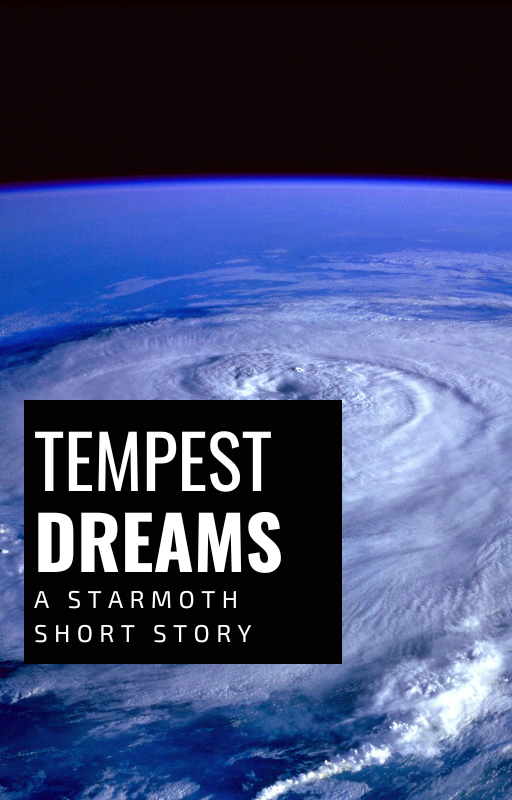
The rain was warm and generous. It came from the sea, carried by the tail end of a storm; it ran down the sapphire windows and into the gardens, muted lights and blind pseudoamphibians perched atop a miniature forest of serene reeds. By the sea gleamed the Saraswati arcology, her pillar linking shore and sky in a river of silver-blue; down into the urban tissue, world-trees whispered to the wind. Isaac-Isabeau sat wide-eyed on their bed. In the sky, all they found was a faint sadness.
“You’re awake,” whispered Talasea.
They shared a bed, yet not a blanket. It was twenty-two degrees Celsius outside, the Pleiadian was cold and the Terran felt warm.
“I haven’t slept,” said Isaac-Isabeau.
They had put their watch face down on the bedside table and lost the measure of time. Yet they could tell midnight had eluded them, for the last spaceplane bound for low orbit had left some time ago in an influx of yellow plumes. Now the maglev runways, far inland in the desolate canyons, remained idle under the storm, silent drones washing burner residue out of their rails. Talasea emerged from the blanket and took Isaac-Isabeau’s hand. They did not retreat; they found her cold, a fragment of an arctic ocean.
“Don’t worry,” they whispered. “Come back to sleep. I’ll ask my monad to secrete a sedative. It has become quite adept at it. Adaptation at work, I suppose.”
“That is not a solution.”
“I am not looking for one. I merely want an exit.”
“Isa.” Talasea looked them in the eyes, and their resolve melted away into a deep serenity. “We have been on Elora for a week and I do not think you’ve had a full night’s sleep. Yet, you’ve already been here. I get that you may take time to attune to a new planet, but this place is familiar to you.”
“Not quite. I’ve never spent so much time on the surface of this planet. Never had the opportunity. And even if I had had it…never had the inclination.”
“Why? Did I make a mistake inviting you here? I thought you’d be right at home on Elora. It is the closest there is to the Earth. The atmospheric pressure, gravity, average temperature, air mix, all are within the optimal parameters to…”
“Tal, I know I once signed a letter *your Terran rose*…”
“Not your best signature.”
“I was tired and madly in love. Yet, and regardless of how much I’d like it to be true, I am no plant. Elora is wonderful. I breathe well, my back doesn’t ache, the light doesn’t hurt my eyes, I don’t have allergies, even the hygrometry is just right for my hair, and you know how rare that is. It’s just that…” They paused. On and on went the rain against the bay windows; elegy for the arcologies. “…it’s not right, Tal. I shouldn’t be here. I do not deserve it.”
“Oh no, Isa, no, no, no, I know you, it is not about self-worth. We are not aboard a spaceship, there is nothing around you that can hurt us, you do not have to shoulder any responsibility, you are not a pilot nor a spationaut anymore, we are together, we are safe, we are at peace. There is something else at play. What I see in your eyes is not anxiety, but dread.” She took them by the shoulders; a gentle touch, friend and lover intertwined. “Please. Tell me.”
“I do not wish to bother you with my fears.”
“I would not be worthy of your affection if I didn’t seek to share your dread as much as your joy. That is true of the lover, the friend, and the navigator. Now, please, tell me.”
They sighed.
“It is the usual curse.”
“The Earth.”
“Yes. The Earth.”
“But why? We are five hundred lightyears from Sol.”
“Distance is irrelevant. It’s just that…” Isaac-Isabeau switched from Arabic to Interlingua. They needed the distance of a conlang. “Elora is too close. Physically, I mean. It’s the rain and the wind. When the sun is up, the differences are obvious to me. The sky doesn’t have the same colour, it is deeper and harsher, it’s like the way incoming light scatters in the stratosphere. It’s different, I can feel it, so it doesn’t scare me. But when the storm comes, when the rain falls and the wind howls and the world-trees flicker, the barrier shatters. I see the Earth and it makes me want to disappear. I...when it rains, Elora is too beautiful a world, you understand? It feels, looks, acts, *smells* like what the Earth could have become, had we not ravaged it, and it is too much to bear.”
“So we are back to the Earth.”
“How could we not? How could *I* not? I was born there. It is my burden, and always will be.”
“There are four billion Earthers…do they all feel like this?”
“No. I don’t think so. Most of them will never leave the planet: they do not know what’s outside, they do not know of the wonders of a garden world. If they’re lucky and willing, they’ll travel the solar system, they’ll see the cities of Lagrange and the O’Neills of Saturn and the domed craters of Mars, that is to say, poor facsimiles of the Earth, and it’ll only reassure them. But I cannot ignore Elora. I cannot ignore the Earth that could have been.”
“You are not responsible for the industrial era. No one alive is.”
“It’s not guilt I feel, Tal. It’s grief. We lost four billion human beings, thousands and thousands of species, landscapes and even shorelines. When you watch historical documentaries, the first thing that strikes you is how *alive* the Earth felt back then. They were birds chirping, insects chittering, forests whispering, even the sky was bluer and fiercer, or maybe it just felt like this because we did not fear its fury back then. A Laniakean once told me that no sapient species should know what a hypercane is. We’ve made a world where the Pacific can become hot enough for four hundred knots winds…this is *wrong*. Deeply, terribly *wrong*, but if you don’t know Elora, you don’t realise this. If the only thing you have is the Earth, then it’s fine, yes, the grief is always there, at the back of your mind, because you *know*, but it’s kept at bay by history. Yet I’m here. On a world teeming with life, where the birds sing and the insects chitter and the hurricanes have the gentleness of a breeze, and I see what could have been. It’s terrifying. We should have never settled this world.”
“Is. Look at me.”
And her eyes were the Pleiades themselves: cold and warm and distant.
“I am.”
“I was born in a place so remote from the Earth that I do not even know what a bird looks like. I have no answer to your grief: I do not think anyone does, if they are honest. I cannot lie. I cannot tell you that everything will be fine and that you do not have to worry, because it is not true. We murdered half our homeworld. It was five hundred years ago. We will not take it back, just like we will not turn Mars green. I am sorry, Is. I genuinely have no answer. I could tell you platitudes, but I would be ashamed of myself. Go in my arms, if you so wish. Try to steal some sleep for the night. Perhaps we will both be wiser come morning.”
It was a pale day, a silvery day: the clouds were low and a ground mist rose from the marshes beyond the dunes. The wind whispered over the beach, and in the distance rose the arcologies and world-trees of Saraswati. The sea was kind and limitless. Creatures were afoot: eight-legged crabs that quarrelled for edible driftwood, pseudoseagulls that cackled as they glided in the breeze, and sentient reeds that moved when no one looked. Isaac-Isabeau had been walking. For how long and how far, only their biometric watch knew, and it was tucked away in their pocket. The beach did not stop for a hundred kilometres, and Isaac-Isabeau had all the time in the world. In the very early morning, they had come across a few passersby, joggers and the odd naturalist, but the crowd had quickly thinned; their last contact with humanity was already an hour behind. They remained attentive to nature: to the harsh caress of the sand under their feet, to the salty taste of the sea-spray, to the rustle of the wind in the pseudo-whin, to the delicate scent of the dunes, which reminded them of everlasting flowers on the Atlantic coast.
They pushed forwards and into the rising fog, which undulated above the waves and sand in a silvery strand. They thought of their mothers, of their peaceful lives on Earth, of their farms and meadows and fields full of skeletons from the age of careless dreams. They’d never been to Elora. They’d never left the Earth, never passed the Karman line, like almost everyone else on the tired planet, and though they rarely discussed it, Isaac-Isabeau wondered if they did not fear the stars. But with time, they had come to a different conclusion: their mothers simply ignored space. The vault of the heavens was no more passable for them than it had been for their distant ancestors of the Low Age, this time not out of incapability, but out of disinterest. And, with all said and done, with the Eloran winds whistling around them and the pseudoreeds running on the shore, all Isaac-Isabeau could now think was that their mothers were right. When Earth was all that one was prepared to know, there was no heaven nor hell, there was no desert nor paradise, there was just the homeworld, and the entire universe contained within. And if the universe was just that – the Earth, and its sum of sorrow and grief and short bursts of wonder – then there was nothing to compare it to. No war-torn Mars to dream about what could have been. No flourishing Elora to reminisce of a time before the great unravelling of the biosphere. Nothing but the cold light of the stars, and the invisible frontier of the mesosphere. A peaceful world.
At some point, Isaac-Isabeau stopped: midday could not be far away. They sat in the sand, their back to a dune. The reeds did not move anymore, even when Isaac-Isabeau looked away; perhaps these were shy. Perhaps they were tired. Perhaps they were actual plants, and not a sentient lichen hybrid. Isaac-Isabeau listened to the rumble of the waves, and they watched the fog rise and rise, until the beach had dissolved into a uniform mass of golden light. Far off the shore, a catamaran whistled as its keel cut its way through the sea. Isaac-Isabeau leaned back and watched the sky. Their right hand found a rocky protrusion in between the reeds, and as they sought to examine it, they determined it was a fossil: the print of a shell on smooth limestone, carried by the deep current that circled the Saraswati Bay or, perhaps, unearthed by the slow erosion of the beach under the steady northward winds. The fossil fit in Isaac-Isabeau’s hand, yet looked like a fragment of a much larger animal, like a nautilus or a similar dweller of the Earth’s ancestral waters; it also lacked the characteristic detailing of modern Eloran life. They took out their hand terminal and queried a local encyclopedia with a picture of the fossil. The answer came within a second: the encyclopedia identified it as a giant pseudoshell from two geological eras prior, a little short of a billion years old. The reconstituted creature, the Regal Shell, had much in common with the nautilus; indeed, if one had added a sack of tentacles and a sailing organ to the venerable animal; painterly artwork depicted it hunting wide-eyed fish in a shallow sea, tending to the young of another, symbiotic species under the cover of a reef, or catching the wind, half-submerged, to sail to another ocean. Enthralled by this window to a world they barely knew, Isaac-Isabeau clicked on the map at the end of the article. It depicted a much different Elora; one that hadn’t been stabilised by its captured moons yet, with raging winds and a vast Pangaea that stretched from one pole to the other, where sprawling vegetation covered every inch of soil, drawing deep canyons made of pseudotrees and pseudomoss, where in the wind shadow of the mountains the flowers towered higher than Mount Everest, where the species hunted and competed with each other, where symbiosis was the exception rather than the rule, and where the sun was harsh and bitter in the sky.
“A billion years ago, Elora was a hotter and more active world,” said the audio track of the embedded documentary. “Archaeologists call this geological era the Aeolian Era, for its geology and biomes were shaped by powerful winds. It is suspected that these winds were caused by drastic temperature gradients themselves due to the erratic seasons, brighter sun and shorter days of the then-moonless planet. At this point in time, Eloran life had already been flourishing for six billion years, and had reached a high degree of sophistication, albeit without the systematic symbiosis we have come to expect from modern biomes. A modern Eloran settler displaced in the Aeolian Era by a quirk of the geometry drive would find a very unfamiliar planet: the air would be saturated with oxygen, the ice caps would go as low as Saraswati Bay during the stellar winter, the weather would be extreme and unstable, bacteria and viruses much more aggressive, and the sky conspicuously devoid of the Interloper and the Vagabond. They would also find a biosphere richer in all dimensions: one with vastly more species, one with towering trees and sprawling shoals of fish, one where higher order species began experimenting with tools and the building blocks of civilisation, one where the continents would not be covered with the same ten species of pseudoplants, but would bear a incredibly complex corpus of lineages, out of which we’ve only managed to identify a fraction of fossils. The richness of the Aeolian era is a testimony of an implacable, yet hard-to-grasp truth: that Elora is a dying planet, two billion years ahead of the Earth in the great march to nothingness. Plate tectonics stopped some ten million years ago. The brightness of our sun has been steadily increasing, and Elora is hotter than it ever was, causing many continents to sink below sea level. Between 95 to 99% of all clades from the Aeolian era have all but disappeared; in terms of sheer loss of diversity, the transition between ancient to present Elora dwarfs even the Permian extinction on Earth. Yet, life has adapted. In the past fifty million years, the rise of symbiotic relationships as the main mode of existence on Elora has…”
Isaac-Isabeau shut their terminal down, turned around and resumed walking, this time towards the arcologies of Saraswati. Halfway to the city, they noticed a reed had found residence in their shawl; they poked the longiline creature, which slithered and quickly retreated to the sands.
“So you were just hitching a ride, hey?” said Isaac-Isabeau to the wind. “You’re right. It was a silly place, back where you came from.”
They caught a tram back to the city, sank in the shower to wash the salt and sadness away, and tried to cook; the result did not satisfy them and they stashed it in the fridge before descending into the narrow streets of the Yalta district and coming back with fish pies. Talasea returned home at six in the evening. Her coat was soaked with rain.
“Sorry. The meeting dragged on,” she said, kissing Isaac-Isabeau on the cheek. “We discussed a revision of emergency procedures for Astropostale escape pods. Do you remember that poor soul from the *Acheron*? Turns out, had the eject timer been correctly set, he wouldn’t have spent six months in a hospital. Half a second was enough to catch the rear antenna, so we’re running a full compatibility check on all our ships. You don’t have to worry about Courier Seven, Bubbles’ already on it. I’ll file this meeting under *boring but also a matter of life and death.* It’s like that, sometimes. Now, pray. How do you feel?”
“Betrayed by Elora. I found a fossil on the beach. My terminal reminded me that we’ve settled a dying planet.”
Dinner was silent. A cold drizzle came with the evening breeze, Saraswati lit up, and Talasea brought her potted plants inside.
“The forecast is gnarly. We’re getting a storm tonight.”
“Then I’ll have an excuse not to sleep.”
“Can I tell you about home? Not about its perfection, but about its necessary demise.”
“I don’t know.” A gust of wind blew over the city; the windows rattled. “I suppose.”
“When we Pleiadians say that we are born in paradise, we mean it. I’ve never visited a station that had the sheer diversity and natural beauty of Alcyone and Merope, even Babylon and Lagrange Five fall short…and yet…well, we do not know how to manage an enclosed ecosystem. Period. And by *we*, I mean humanity, as a whole. This is just not something we have the technical know-how or theoretical arsenal to tackle. We can reach a good approximation of it, but the real deal remains out of our reach.”
“Tal, we’ve been building O’Neills for the past century.”
“Yes, and the oldest ones aren’t in good shape. Babylon Port is suffering from a marked biodiversity decline, and Lagrange Five would be barren if it weren’t for decadal overhauls. The truth is that maintaining an enclosed ecosystem is a daunting task, and in many ways I’d say it’s a good order of magnitude harder than mastering slower-than-light interstellar travel. There are about one million species, including bacteria, on a standard O’Neill. It is impossible to control all the feedback loops between them, and it’s also impossible to rip out the inner layer of my home station and replace it, should it begin to leak and disturb the carbon-oxygen cycle. And it *will* leak, one day or another, and I don’t really know what happens then. It’s insane, I come from an insane place, a tin can with a fully artificial biosphere imprisoned inside, and us playing with bacteria and moss and algae like kids with a loaded gun. We don’t know how to do this, we’re merely pretending. Merope and Alcyone *will* fail, wither away, and turn into empty cylinders with nothing but dry riverbeds and desiccated forests to show for it. Every single model shows that, be it in seventy years or in a millennium. Space stations are no safer from entropy than settled planets, in fact, they decline faster. And yet…” She took Isaac-Isabeau’s hand.
“Yet you don’t fall into despair,” they said. “But I am not sure it’s comparable. I know the lifespans of O’Neills are measured in centuries at best…and you’ve already said that everything in the Pleiades feels fleeting, even your stars, that weren’t even there when the dinosaurs died. But I think the Earth is the exact opposite. Everything here is permanent. It accumulates: in the soil, in the sea, in the very air we breathe. I have microplastics in my lungs, in my liver, in my brain even, and if you sampled them, you’d find that most of them are more than five hundred years old. I’m not sure where we are going with this, Tal. We’ve just come to the conclusion that everything around us is dying, and that it’s just a matter of time and failure mode. This is not helping. At all.”
“I don’t have a witty aphorism or a cool and mysterious Pleiadian ritual to get out of this, Is. The Earth will never be what it once was. Elora is in the last stage of its existence as a garden world. My home will be a desert in a few centuries. The Milky Way is a graveyard of civilisations. These are all unescapable truths. We live among them.” She shrugged, but also had the kindest of smiles, the one that had made Isaac-Isabeau fall in love, a short decade prior, in the windy streets of a snow-covered city. “And *you* live among them, which is reason enough to endure.”
The storm raged on all night long; it crashed against the windows, whistled around the arcologies, flooded the courtyards and scared the pseudo-seagulls into hiding. Isaac-Isabeau and Talasea slept in separate beds, as they often did when the weather was inclement, for she craved the song of the wind and they feared it; they kept the shutters down, and she opened them as soon as the worst of the storm had passed, to feel these wild gusts that never occurred on Alcyone, and to smell the burning scent of the rain on warm coral. Come morning, there was peace. Isaac-Isabeau and Talasea went for a stroll on the beach. The storm had washed the fog away, and the reeds had burrowed underground; there remained a long strip of sand that slithered into nothingness, and the quiet rumble of the waves. A kilometre out of Saraswati, they found white wings, a torn fuselage and a crowd of umbrellas. A highflyer UAV had crashed, carried into the troposphere by the tail end of the storm and torn apart by the winds; fisherfolk and engineers from the nearby commune were already at work on the wounded beast, trying to pry the black box away, recovering the broken fragments of the hull, carrying the wings to a little airship that dutifully stood above the dunes. Isaac-Isabeau and Talasea lent a hand; as they were not familiar with highflyers, the fisherfolk put them on beach cleaning duty. Two hours, a bucketful of carbon fibre and a hearty meal later, there was nothing left of the fallen giant, or indeed the fisherfolk.
“But then,” asked Isaac-Isabeau as they sat in the dunes to watch the sea come and go. “If there’s no escape, what do we *do*?”
“What we’ve always done,” replied Talasea. “We get moving again.”
It was a clear day with nary a cloud, six thousand metres above the Saraswati Bay and its gleaming arcologies. The Astropostale shuttle *Psyche* flew at twice the speed of the sound, and the air moved swiftly around its sharp fuselage; caught between sea and zenith, the chrome finish had taken on the colour of lazulite. There were seven tons of handwritten letters in the cargo hull: a little short of a million words of love, of hate, of extraordinary occurrences and of mundane happenstance. Two mailfolk helmed the ship. Their orange flight suits harkened back to the pale days of the industrial era, before the great dereliction of the dream. The cockpit smelled of tea and lilac.
“Greenlight on all systems,” said Talasea on the radio. “Psyche is requesting permission to engage primary drive.”
“Saraswati control to Psyche,” answered a voice in Hindi. “The coast is clear, you are go for ascent, execute at your leisure.”
“Isa?”
“Got it.”
They flicked the safety switches, transitioned the straight wings to a delta, angled the ship upwards and pushed the throttle. The aerospike engine roared, and a golden flame began trailing the Psyche. Isaac-Isabeau breathed out under three gravities of thrust.
“Psyche has begun vertical ascent flight. All parameters nominal, see you in orbit.”
“Likewise, Psyche, and good path to the stars.”
Isaac-Isabeau turned their eyes towards heaven’s vault, towards the great arch where sky dissolved into space, where blue became black and the icy clouds shone in direct sunlight, and thought: am I at peace?
No. There could be no peace. They had killed the Earth, Elora was dying, and Talasea’s home a grave in waiting. But at seven kilometres per second and accelerating, flying vertical towards the great expanse, side-by-side with the only person they’d have given the universe for – yes, there was, perhaps, something that approached peace.
And in the faint glow of the charted stars, it felt enough.
All content in the Starmoth Blog is © Isilanka
Written content on Starmoth is distributed under a Creative Commons Attribution Non-Commercial Share-Alike 4.0 license